 Diagnostics · NYC
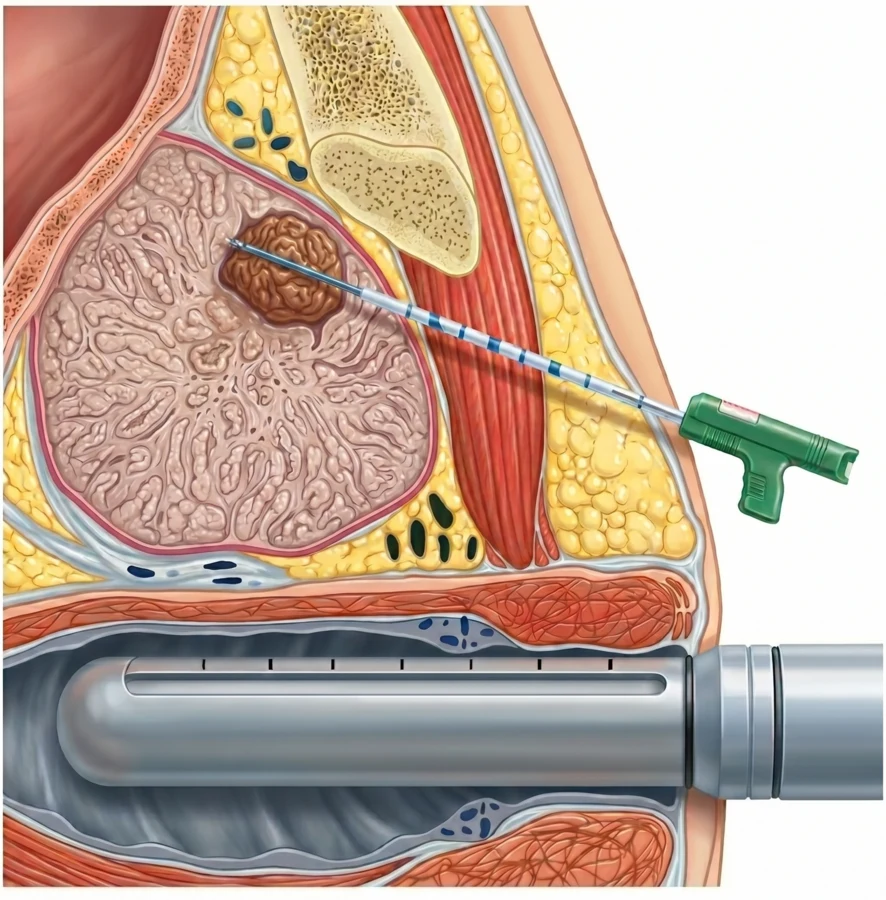
Transperineal MRI/US Fusion Prostate Biopsy
A transperineal prostate biopsy samples the prostate through the skin between the scrotum and anus, rather than through the rectum. Using MRI/ultrasound fusion guidance, the biopsy needle is precisely directed to suspicious areas of the prostate as well as systematic sampling zones. Because the needle does not pass through the rectal wall, the risk of serious rectal-source infection, including sepsis, is markedly reduced, and antibiotics are generally not required routinely.
Dr. Tan performs more than 500 transperineal prostate biopsies per year in the office using local anesthesia, without sedation. Published outcomes show low pain scores with this office-based local anesthesia technique. Patients walk in, have the procedure, and walk out the same day. For patients who are anxious, Pro-Nox nitrous oxide is also available.
"Performing the biopsy through the perineum, rather than through the rectum, avoids passing the needle through the bowel wall. This is a major reason the infection risk is so low."- Dr. Wei Phin Tan, MD, MHS, FACS
Transperineal vs. Transrectal Biopsy
| Transperineal (Dr. Tan) | Transrectal | |
|---|---|---|
| Infection Risk | Markedly lower with transperineal biopsy | Higher with transrectal biopsy |
| Sepsis Risk | Very rare with transperineal biopsy | Higher than transperineal |
| Antibiotics | None required | Required |
| Enema | Yes, improves visualization | Required |
| Anesthesia | Local (office) | Varies |
| Cancer Detection | Equivalent or better | Baseline |
What Makes This Different
- Office-based under local anesthesia, no operating room, no general anesthesia
- MRI fusion-guided, targeted sampling of MRI-visible lesions
- Published low pain scores using an office-based local anesthesia technique
- Pronox (nitrous oxide) available for anxious patients
- No antibiotics because the needle avoids the rectal wall
- 500+ procedures per year, volume with outcomes
What to Expect
- Consultation. Review PSA trend, prior imaging, and risk factors.
- MRI. A multiparametric MRI is obtained if not already available.
- Biopsy day. Enema, local anesthesia, office-based procedure. Pronox available on request.
- Pathology. Results reviewed with you in follow-up, with integrated discussion of next steps, from surveillance to focal therapy to surgery.
Selected Evidence (Dr. Tan's Published Work)
Dr. Tan has published on prostate biopsy infection prevention, antibiotic resistance, and biopsy specimen processing:
- Tan WP, Tan WK, et al. Effectiveness of intrarectal povidone-iodine cleansing plus formalin disinfection for transrectal biopsy infection prevention. Journal of Urology. 2023. PMID 36484448
- Tan WP, Papagiannopoulos D, Latchamsetty KC, et al. Predictors of fluoroquinolone-resistant bacteria in the rectal vault of men undergoing prostate biopsy. Prostate Cancer and Prostatic Diseases. 2019. PMID 30279581
- Tan WP, Mazzone A, Shors S, et al. Central zone lesions on MRI: clinical significance for biopsy planning. Urologic Oncology. 2017. PMID 27692837
- Deane LA, Tan WP, Strong A, et al. Lowering positive margin rates at radical prostatectomy by color coding biopsy specimens. International Brazilian Journal of Urology. 2018. PMID 30044594
Full publication list pulled live from PubMed on the Publications page.