 Robotic Surgery · NYC
Precision Robotic Prostatectomy for Prostate Cancer in NYC
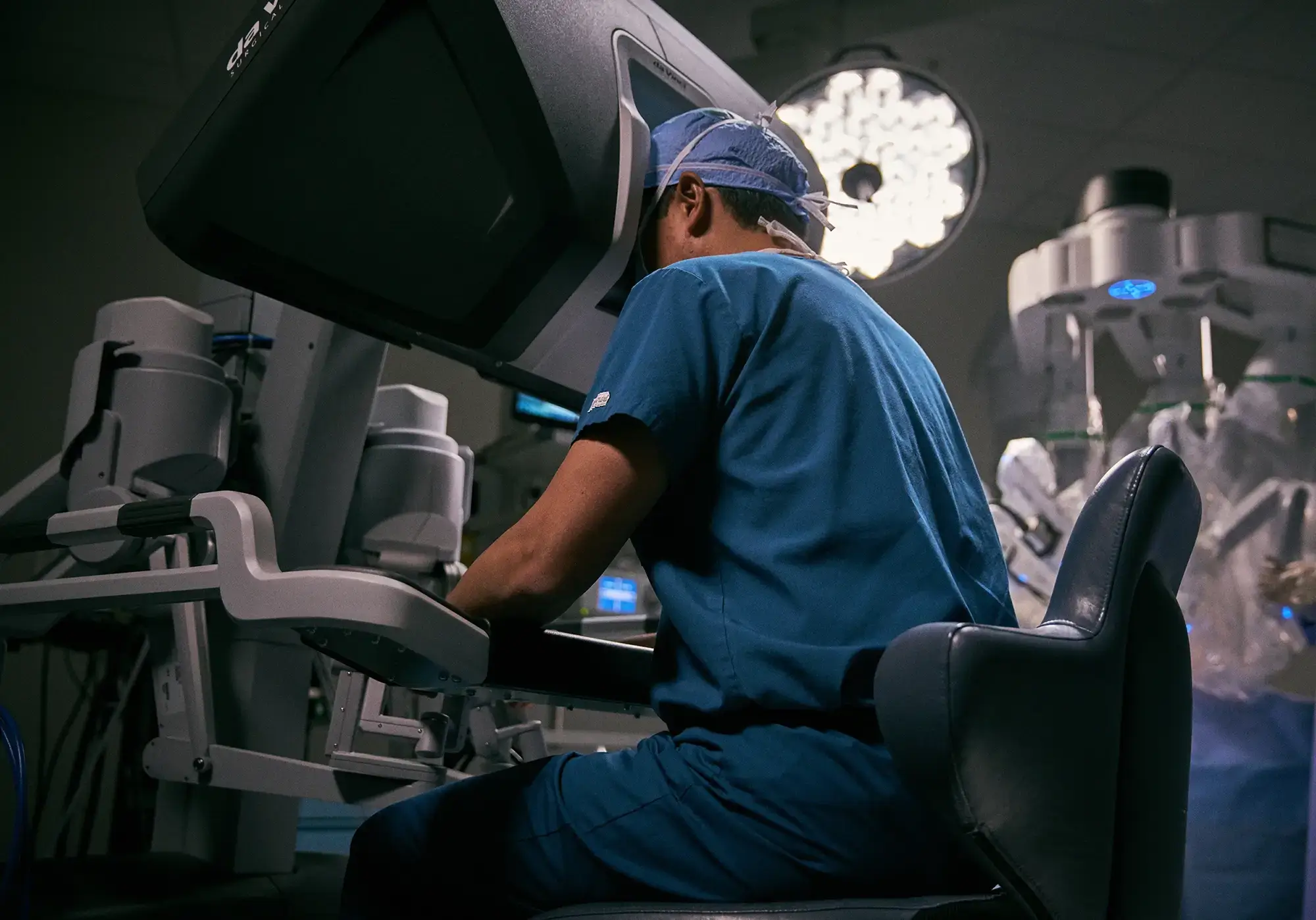
Robotic prostatectomy removes the entire prostate using the da Vinci surgical robot through several small keyhole incisions. It is the most commonly used contemporary surgical approach for localized prostate cancer. Dr. Tan's Precision Prostatectomy is a long urethral-sparing robotic technique designed to improve early urinary control while maintaining oncologic control.
Most patients in Dr. Tan's practice are discharged the same day. The catheter is typically removed on day 5, and some patients have urinary control immediately after catheter removal. The technique was featured in an NYU Langone Physician Focus case, "Precision Robotic Prostatectomy: Maximizing Function While Maintaining Oncologic Control."
"With long urethral sparing, the goal is to improve early urinary control after catheter removal, often around day five. Some patients have excellent control immediately, while others recover over the following weeks to months."- Dr. Wei Phin Tan, MD, MHS, FACS
Advantages Over Open Surgery
Compared with open surgery, robotic prostatectomy is associated with smaller incisions, less blood loss, shorter hospital stay, and enhanced 3D visualization for precise dissection. Functional recovery still depends on the patient's baseline function, anatomy, cancer location, and surgical technique.
- Less blood loss than open prostatectomy
- Shorter hospital stay, with same-day discharge for many patients
- 3D HD visualization for precise nerve-sparing dissection
- Smaller incisions and faster early recovery
- Tailored nerve-sparing and urethral preservation based on the patient's cancer location and anatomy
What to Expect
- Consultation and staging. MRI, PSA, biopsy results, prostate size, urinary function, and cancer risk are reviewed. Together, we discuss surgery, focal therapy, radiation, and active surveillance when appropriate.
- Pre-op planning. Nerve-sparing goals and urethral preservation are discussed in detail. Imaging is reviewed to understand the relationship between the cancer, prostate apex, bladder neck, neurovascular bundles, and any median lobe anatomy.
- Surgery. Robotic-assisted long urethral-sparing prostatectomy is performed under general anesthesia. Most patients go home the same day.
- Catheter removal around day 5. Some patients are continent immediately after catheter removal. Others improve over the following weeks to months.
- Follow-up. PSA is monitored every 3 to 6 months initially. Pelvic floor rehabilitation is used as needed.
Frequently Asked Questions
What is a Precision Prostatectomy?
How long is recovery?
Will I be continent?
Should I choose surgery or focal therapy?
Selected Evidence (Dr. Tan's Published Work)
Selected publications relevant to prostate cancer surgical decision-making:
- Ghoreifi A, Hussain J, Tan WP, et al. Comparative effectiveness of partial gland cryoablation vs robotic radical prostatectomy. European Urology Focus. 2025. PMID 39893046
- Tan WP, Rastinehad AR, Klotz L, et al. Focal therapy for patients discontinuing active surveillance, Delphi consensus. Urologic Oncology. 2021. PMID 33676851
- Deane LA, Tan WP, Strong A, et al. Lowering positive margin rates at radical prostatectomy by color-coding biopsy specimens. International Brazilian Journal of Urology. 2018. PMID 30044594
- Tan WP, Lin C, Chen M, Deane LA. Periprostatic Fat: A Risk Factor for Prostate Cancer? Urology. 2016;98:107-112. PMID 27592523
Full publication list pulled live from PubMed on the Publications page.